

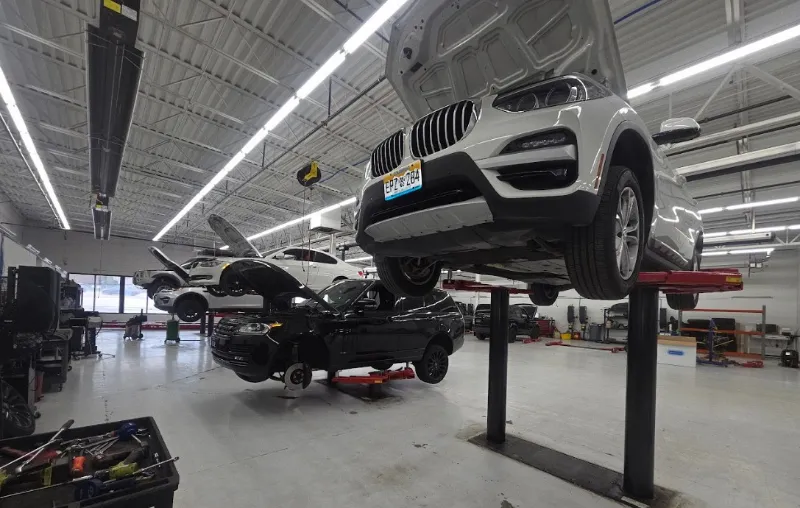
When Your Mercedes-Benz Acts Up in Englewood, Every Minute Counts
You bought the Mercedes because it was supposed to feel effortless. Quiet cabin, confident handling, the kind of car that turns a commute down Santa Fe Drive into something close to enjoyable. Then one morning the AIRMATIC suspension sags overnight, or the check engine light flicks on halfway to a client meeting, or the climate control just stops blowing cold while you’re stuck in I-25 traffic in 105-degree heat. The car that was supposed to be effortless suddenly feels like a second job.
That’s where we come in. JCB Euro at 4747 S. Santa Fe Dr. in Englewood has been diagnosing and repairing European vehicles since 2005 — over two decades evolving from JC’s British & 4×4 into the Mercedes-Benz specialists Denver-Metro drivers actually trust. Our ASE Master Certified technicians know what fails on these cars, why it fails, and how to fix it once. Call 720-548-6804 and we’ll get your Mercedes diagnosed quickly, explained honestly, and back on the road right.
Common Reasons Your Mercedes-Benz Needs Repair
Mercedes engineers brilliant vehicles. They also engineer complex ones — and complexity has predictable failure points. We approach every Mercedes the same way: systematic diagnostics with factory-level scan tools, then a written estimate explaining what’s wrong, what’s urgent, and what can wait. No guessing, no parts-swapping, no surprise add-ons. Here are the issues we see most often on Denver-Metro Mercedes models.
AIRMATIC Air Suspension Failure
The AIRMATIC system on GLE, GLS, S-Class, E-Class, and G-Class vehicles uses air struts, an electric compressor, and a network of sensors and valves to deliver that signature Mercedes ride. Colorado’s temperature swings — 20-degree mornings to 90-degree afternoons in a single week — are brutal on the rubber air springs. Compressors burn out from constantly working to keep up with leaks. Once one component goes, the others follow.
Symptoms include:
- The car sitting noticeably lower on one corner (or all four) after sitting overnight
- A “Vehicle Too Low” or “AIRMATIC Visit Workshop” warning on the dash
- The compressor running constantly or not running at all
We diagnose AIRMATIC failures by load-testing the compressor, pressure-testing the lines, and scanning the suspension control module for fault history. That tells us whether you need a single strut, a compressor rebuild, or a full system refresh — not a guess. Learn more about our Mercedes-Benz AIRMATIC air suspension repair.
Overdue Flex A or Flex B Service
Mercedes Flex Service is the manufacturer’s scheduled maintenance system — Service A at roughly 10,000 miles, Service B at 20,000 miles, alternating. When customers skip these or let the dealer turn them into $1,500 invoices full of “recommended” extras, problems compound. Old oil thickens at altitude. Cabin filters clog and overwork the blower motor. Brake fluid absorbs moisture and corrodes ABS components from the inside.
Symptoms include:
- The “Service A” or “Service B” reminder appearing on the instrument cluster
- Weak airflow from the vents or unusual cabin odors
- Slightly longer brake pedal travel as fluid degrades
We perform Mercedes-Benz Flex A Service and Mercedes-Benz Flex B Service exactly to factory specification using approved fluids and OEM filters — without the dealer’s upsell theater. You get the receipt and the service light reset, and your warranty paper trail stays intact.
Check Engine Light and Drivability Issues
Mercedes engines — particularly the M276 V6 and M278 V8 — have known issues with timing chain tensioners, camshaft adjusters, and intake manifold runners. Add Colorado’s altitude (thinner air, harder-working forced induction) and you get a vehicle that throws codes corner shops can’t interpret correctly. A misread code becomes a wrong part, which becomes a wrong repair, which becomes the second-opinion call we get every week.
Symptoms include:
- Illuminated check engine light, sometimes flashing
- Rough idle, hesitation under acceleration, or a noticeable drop in fuel economy
- A faint rattle on cold startup that quiets after a few seconds
We use factory-level diagnostic tools — not generic OBD-II readers — to pull live data, freeze-frame information, and module-specific codes. That’s the difference between treating a symptom and finding the actual fault. Start with our check engine light diagnostics.
ADAS Sensor Calibration After Repairs or Glass Replacement
Modern Mercedes models rely on cameras, radar units, and ultrasonic sensors to power active lane keeping, adaptive cruise, blind-spot monitoring, and emergency braking. Any windshield replacement, suspension repair, alignment, or front-end bodywork can knock these sensors out of calibration. A sensor that’s off by a fraction of a degree at the bumper can be off by feet at the end of the road — and that’s the system supposed to brake for your kids.
Symptoms include:
- Lane assist tugging the wheel unexpectedly or failing to engage
- Adaptive cruise dropping out or braking erratically
- “Driver Assistance Inoperative” or similar warnings on the cluster
We have the factory targets, calibration mats, and software to perform static and dynamic recalibration in-house. See our Mercedes-Benz Advanced Driver Assistance sensor calibration page.
Climate Control and AC System Failures
Mercedes climate systems are dual-zone, multi-zone, sometimes four-zone — and every zone has its own actuator, blend door, and temperature sensor. When parked interior temps in Colorado summer hit 139 degrees, the compressor works overtime. Refrigerant leaks at O-rings, evaporators corrode, and the auxiliary water pump that keeps coolant flowing through the heater core often fails silently.
Symptoms include:
- AC blowing cold on one side and warm on the other
- Weak airflow even at the highest fan setting
- A clicking sound behind the dash when changing temperature
We pinpoint AC and HVAC faults with UV dye, electronic leak detection, and full system pressure testing before recommending repair. Visit our auto air conditioning repair page for more.
Brake Wear and Sensor Faults
Mercedes brakes wear faster than many owners expect — the soft compound is designed for stopping power, not longevity. Add Denver-Metro elevation changes and the I-70 descent from the mountains, and brake pads and rotors take a beating. Mercedes also uses brake wear sensors that trigger dash warnings, and ignoring them means rotor damage that doubles the repair cost.
Symptoms include:
- “Brake Pad Wear” warning on the instrument cluster
- Squealing or grinding when braking, especially at low speed
- Pulsation through the pedal under firm braking
We use OEM-quality pads and rotors matched to your specific model — not generic parts that dust heavily and wear unevenly. Learn more about our brake repair and replacement service.
Why Choose JCB Euro for Mercedes-Benz Diagnosis
Accurate Diagnosis the First Time
Our ASE Master Certified technicians use Mercedes-specific diagnostic equipment — the same factory-level tools the dealer uses — to read every module on your vehicle, not just the engine. That means we catch issues other shops miss and avoid the parts-swap guessing game that runs your bill up. Every service starts with thorough diagnostics so we can tell you exactly what’s wrong before you commit to anything.
Transparent Communication
You receive a written estimate before any work begins. We explain in plain language what’s urgent, what can wait six months, and what doesn’t make sense to fix at all. No pressure tactics, no surprise charges, no shop-supply fees buried in the total. You make the final call — and you’ll always know why we’re recommending what we’re recommending.
Convenient Service Backed by a Real Warranty
We’re located at 4747 S. Santa Fe Dr. in Englewood — minutes from Cherry Hills Village, Greenwood Village, Littleton, and South Denver. We stand behind every repair with an industry-leading 5-year / 50,000-mile warranty, and we’re BBB Accredited. If your Mercedes is disabled, call us about towing options before you call a flatbed.
Preventing Future Mercedes-Benz Problems
Most expensive Mercedes repairs we see started as inexpensive maintenance somebody postponed. Here’s how to stay ahead of the curve.
Stay on the factory maintenance schedule. Mercedes designed the Flex A and Flex B service intervals for a reason. At Colorado altitude, where engines and turbos work harder, sticking to them matters even more.
- Don’t stretch oil changes past the recommended interval — heat and altitude break oil down faster here than in other climates
- Replace cabin air filters annually; clogged filters strain the blower motor and shorten its life
- Address Service A and Service B reminders promptly rather than waiting for problems to compound
Treat warning lights as information, not annoyances. Mercedes electronics tell you exactly what’s happening if you respond early. A pad wear sensor caught on time means replacing pads. Ignored, it means new rotors and possibly calipers.
- Get any check engine light scanned within a week — see our check engine light service
- Address AIRMATIC and suspension warnings before a single strut becomes a full system replacement
Build a relationship with one shop. Mercedes records benefit from continuity. When the same technicians know your vehicle’s history, diagnostics get faster and repairs get smarter. A regular oil change and consistent scheduled vehicle maintenance with the same shop pays dividends in long-term reliability.
Schedule Your Mercedes-Benz Repair Today in Englewood
If your Mercedes is making a noise it shouldn’t, showing a warning you don’t recognize, or just hasn’t felt right lately — get it looked at by people who actually know these cars. We’ll diagnose the real problem, give you a written estimate, and explain your options before doing a single thing you didn’t approve.
Call JCB Euro at 720-548-6804 to schedule. We’re located at 4747 S. Santa Fe Dr., Englewood, CO 80110, serving Mercedes owners across Denver, Littleton, Highlands Ranch, Cherry Hills Village, Greenwood Village, and the rest of the Denver-Metro area. If your Mercedes can’t make it in under its own power, call us first — we’ll help coordinate towing and get you back on the road faster than the dealer’s three-week waiting list ever could. Find directions and reviews on our Google Business Profile, or browse our full list of auto repair services and Mercedes-Benz repair capabilities.
Frequently Asked Questions
How do I tell if it’s an AIRMATIC suspension problem or a regular shock issue?
How do I tell if it’s an AIRMATIC suspension problem or a regular shock issue? AIRMATIC issues almost always come with a dash warning like “Vehicle Too Low” or “AIRMATIC Visit Workshop,” and the car often sits unevenly after parking overnight as air leaks out. Conventional shock or strut wear shows up as bouncing, nose-diving under braking, or clunking over bumps without any dash message. We confirm the difference with a scan tool and compressor load test before recommending repair.
Why does my Mercedes check engine light come on sometimes but not other times?
Why does my Mercedes check engine light come on sometimes but not other times? Why does my Mercedes check engine light come on sometimes but not other times? Intermittent lights usually point to issues like loose connections, a marginal sensor, a partially clogged component, or temperature-sensitive faults. Mercedes stores freeze-frame data every time the light triggers, and our factory-level scan tools can read that history even when the light isn’t currently on. That’s how we catch intermittent problems other shops can’t reproduce.
Does Colorado’s altitude and temperature swing really affect Mercedes repairs?
Does Colorado’s altitude and temperature swing really affect Mercedes repairs? Does Colorado’s altitude and temperature swing really affect Mercedes repairs? Yes, significantly. Thinner air at altitude makes turbocharged engines work harder, accelerating wear on intake components and oil. Temperature swings from below freezing to over 100 degrees stress rubber components like air suspension bladders, AC O-rings, and coolant hoses. We see Colorado-specific failure patterns the dealer’s national service bulletins don’t always emphasize.
What should I do right now if my Mercedes is showing a serious warning and I’m not at home?
What should I do right now if my Mercedes is showing a serious warning and I’m not at home? What should I do right now if my Mercedes is showing a serious warning and I’m not at home? For red warnings like brake, oil pressure, or coolant temperature, pull over safely and shut the engine off — continuing to drive can turn a repair into a replacement. For yellow warnings, you generally have time to get home or to a safe location, but don’t postpone diagnosis. Call us at 720-548-6804 and we’ll advise on whether to drive in or arrange towing.
How long does Mercedes-Benz diagnosis take at your shop?
How long does Mercedes-Benz diagnosis take at your shop? How long does Mercedes-Benz diagnosis take at your shop? Most diagnoses take two to four hours once we have the vehicle, and we communicate findings the same day or next morning. Complex intermittent issues or multi-module faults can take longer, but we’ll always tell you up front what we expect and never run up diagnostic time without your approval. You’ll get a written estimate before any repair work begins.