

Stop Gambling With Your Vehicle’s Most Expensive Component
You’re at the dealership, staring at a quote for transmission fluid service that makes your stomach drop. The service advisor throws around technical jargon that leaves you feeling confused and exploited. Or maybe you’ve already tried an independent shop, spent your hard-earned money, and still have unresolved issues that keep you up at night.
Here’s the truth: your transmission is the most expensive component in your vehicle to replace, often costing between $8,000 and $15,000. The leading cause of catastrophic transmission failure isn’t bad luck—it’s neglected fluid service. Ignoring or improperly performing this single maintenance item can destroy a transmission that should have lasted the lifetime of your vehicle.
The automotive service industry has created a perfect storm of confusion for vehicle owners. Dealerships overcharge dramatically, treating transmission service as a profit center. Meanwhile, general mechanics often lack the specialized expertise, equipment, and training required for modern transmissions. This leaves you frustrated, anxious, and doubting whether you can trust your vehicle. But it doesn’t have to be this way.
Why Transmission Fluid Service Matters
Transmission fluid is far more than just a lubricant—it’s the lifeblood of your vehicle’s transmission system. It performs four critical jobs: lubricating moving parts, cooling the system, providing hydraulic pressure for gear changes, and preventing corrosion.
Over time, even the highest-quality transmission fluid breaks down. Heat degrades its molecular structure, additives become depleted, and contaminants like metal particles and moisture accumulate. When fluid degrades beyond its effective service life, problems begin. You might notice harsh or delayed shifting, slipping, overheating, or even complete transmission failure.
Modern transmissions are highly sophisticated, featuring eight, nine, or even ten speeds with computer-controlled systems. They require specific fluids and precise service procedures. Using the wrong fluid or following improper methods can cause long-term damage that shortens the transmission’s lifespan.
The JCB Euro Difference
At JCB Euro, located at 4747 S. Santa Fe Dr., Englewood, CO 80110, we offer expert transmission service without dealership exploitation or the uncertainty of working with shops that lack specialized knowledge. Our technicians have invested thousands of hours in training, specializing in the precise, manufacturer-specific procedures necessary to protect your vehicle’s transmission.
We understand that your vehicle represents a significant investment and that you depend on it for work, family, and freedom. That’s why we approach every transmission service with the seriousness it deserves, treating your vehicle with the same care we’d give our own.
What Sets Us Apart
Manufacturer-Specific Fluids and Procedures Modern transmissions require specific fluids formulated for their unique designs. We maintain an extensive inventory of manufacturer-specific fluids, ensuring we use the exact fluid your vehicle requires—not generic alternatives. Our service procedures follow manufacturer guidelines precisely, accounting for unique transmission designs and ensuring proper fill levels using the correct measurement methods. We also perform necessary computer resets and adaptations, allowing your transmission’s computer to relearn optimal shift points with fresh fluid.
We perform thorough fluid exchanges using specialized equipment, not the partial drain-and-fill approach many shops use. A complete exchange removes contaminated fluid from the torque converter, valve body, and all passages, replacing it entirely with fresh, clean fluid.
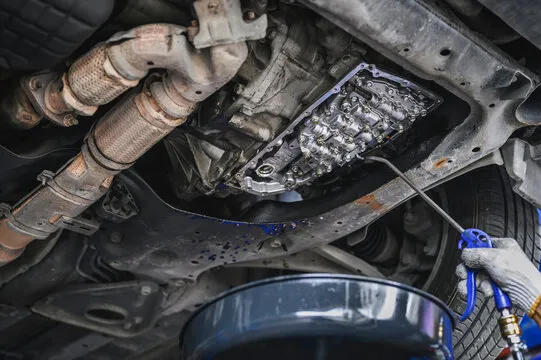
Comprehensive Inspection and Documentation Every transmission service includes a detailed inspection. We remove the transmission pan to inspect the filter and examine the fluid and any debris for signs of wear or potential problems. We provide photos and videos of our findings, helping you understand what’s normal wear versus potential issues. This documentation becomes part of your vehicle’s service history, valuable for future maintenance decisions and resale value.
Honest Recommendations We prioritize your actual needs, telling you what’s urgent, what’s important for preventive maintenance, and what can wait. If your transmission fluid doesn’t need service yet, we’ll tell you honestly and recommend when to return. If we find issues beyond fluid service, we’ll explain them clearly and let you make informed decisions.
Transparent Communication We use plain language, visual aids, and clear explanations to help you understand your transmission’s condition and our recommendations. You’ll never feel talked down to or confused by unnecessary jargon. Our goal is to educate and empower you to make confident decisions about your vehicle’s care.
The Cost of Delaying Service
Delaying necessary transmission service creates risks that grow exponentially over time. Degraded fluid leads to increased wear, damaged components, and eventually catastrophic failure. When a transmission fails completely, you’re not just facing repair costs—you’re dealing with towing expenses, rental car fees, lost work time, and the stress of unexpected vehicle problems.
Proper transmission service isn’t just an expense—it’s insurance against failure. It’s the difference between planned, affordable maintenance and emergency repairs that devastate your budget. Regular service restores your confidence in your vehicle, eliminating the constant worry about shifting problems or sudden failure.
Our Service Process
Step 1: Consultation and Inspection
Every transmission service begins with a conversation. We want to understand your vehicle’s history, how you use it, and any concerns you’ve noticed. Then, we perform a thorough inspection, connecting advanced diagnostic equipment to scan for fault codes, checking fluid condition, and performing test drives to evaluate shifting quality. We also conduct visual inspections underneath your vehicle, looking for leaks or signs of overheating.
Step 2: Transparent Recommendations
After our inspection, we provide clear, prioritized recommendations. Critical items require immediate attention, important items represent preventive maintenance, and monitor items are conditions to check during future visits. You’ll receive a detailed estimate explaining the benefits of each service and the risks of delaying it. We only proceed with work after receiving your explicit approval—no surprise charges, no unauthorized repairs.
Step 3: Expert Fluid Service
Our certified technicians use specialized equipment for thorough fluid exchanges. We replace filters, clean the transmission pan, and inspect the magnetic drain plug for metallic particles. We install new gaskets or seals as needed and fill with the correct fluid to the precise level. Finally, we reset adaptive learning parameters in your transmission’s computer, allowing it to relearn optimal shift points with fresh fluid.
Step 4: Documentation and Follow-Up
After completing your service, we provide comprehensive documentation, including before-and-after photos of the fluid, pan interior, and filter. We explain what we found and what we did, and we give you recommendations for future maintenance. This documentation becomes part of your vehicle’s permanent service record, supporting resale value. We also follow up to ensure your satisfaction and that your transmission is performing as it should.